
Water of Hope: Mele Community Officially Opens its Rehabilitated Water System
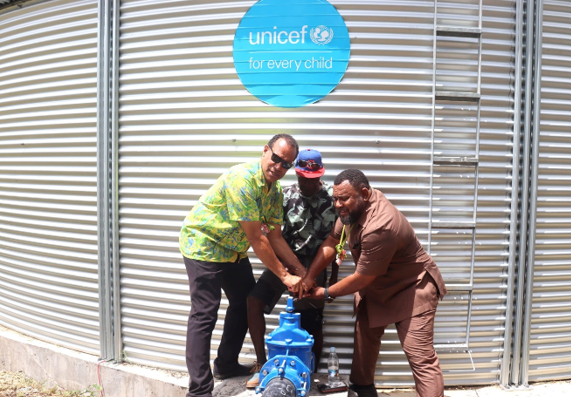
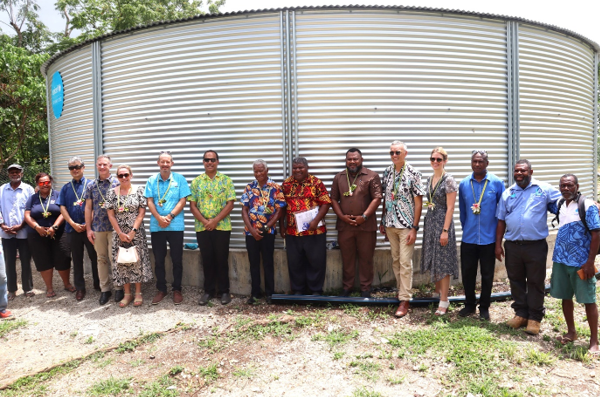
Mele, Efate, Vanuatu – The Department of Water Resources (DoWR) and Mele Water Community officially opened the valve to begin using the rehabilitated Mele water system, including a brand-new 300,000-litre water storage tank.
This milestone marks the successful completion of Phase One of the Mele Water Rehabilitation Project and a significant step towards restoring accessibility to safe, reliable water for more than 8,000 residents of Mele, the largest village on Efate. The Honourable Rick Tchamako Mahe, Minister of Lands and Natural Resources, said “At the heart of our work in the Ministry of Lands and Natural Resources is a simple but powerful principle: every Ni-Vanuatu citizen should have access to safe water in sufficient quantities to meet basic needs for drinking, cooking, sanitation, and hygiene”. The devastating 7.3 magnitude Port Vila earthquake in 2024 caused landslides that severely damaged the Mele water supply system. The disaster destroyed two existing water tanks, buried pipelines, and cut off access to the water source, forcing families to rely on rainwater harvesting, rivers, and unsafe boreholes to address their water needs. The Honourable Minister for Climate Change and Disaster Management, Ralph Regenvanu said, “Accessibility to safe reliable water is not just about quantity, but about ensuring water is safe and clean. Safe drinking water is a fundamental human right.”
The National Disaster Management Office (NDMO) communicated this priority recovery need to be included in the recovery plan for the 2024 earthquake in Port Vila. The NDMO acknowledges the initiative, facilitation and proactiveness approach displayed by the community of Mele towards the cooperation with the Department of Water Resources, which is an active member of the WASH Cluster, along with partners such as UNICEF, that has resulted in a rehabilitated Mele village’s water supply system. Phase One of the project focused on restoring the backbone of the system, from source to storage. DoWR, UNICEF, and Mele communities joined hands to identify a viable route from the catchment area to the tank site, by laying a new pipeline, demolishing the old two tanks and constructing a new 300,000L storage tank. With this phase completed, water is once again flowing safely into storage for the community. This achievement reflects a strong partnership between the Mele community, the Mele Water Committee, the Department of Water Resources, UNICEF, and generous development partners.
The Mele community contributed extensively by clearing bush, creating road access, digging trenches for the pipes and constructing a fence around the new tank. The entire process has been closely managed by UNICEF and DoWR to ensure quality, safety, and sustainability. “Water is life for our community,” said Michel Taravaki, Chairman of the Mele Water Supply Committee. “After the earthquake, the two water tanks were broken, all the pipes were damaged, and landslides buried the system. For more than a month, people walked to rivers to collect water. Children became sick, families struggled, and life was not normal. Today, opening this valve feels like a Christmas gift for Mele.
Hope has returned.” Michel, who has served as Chairman for four years, emphasised the unity shown by the community. From August 2025, 30 to 40 community members volunteered every week – clearing bush to reach the distant water source, preparing food for workers, providing transport, and supporting technical teams. After two failed route options, the community successfully identified a third pipeline route in September, a breakthrough that made the project possible.
The impact on children has been profound. Aurora, a 13-year-old Year 7 student at Melemaat School, shared how water shortages disrupted her daily life. “After the earthquake, every day I had to go to the river to get water,” Aurora said. “School was difficult because there was no water, and we had to help our families instead of playing. I can’t wait for the water to be back at home so I can have more time to study and play with my friends.” For mothers and caregivers, the restored system brings relief and dignity. Leisva Vatoko, a mother and community volunteer, described the hardship families endured. “Since the earthquake, it was very hard for everyone – carrying heavy buckets from the river, worrying about dirty water making our children sick,” she said. “This project is a dream come true. We thank UNICEF, the Department of Water Resources, development partners, and our own community for working hand in hand. What we talked about for years is now becoming reality.”
Minister Regenvanu emphasised in his speech that “Mele’s rehabilitated water supply system showcases the resilience of the community of Mele and is an example of Vanuatu’s Disaster Risk Management objective that disaster preparedness, preparations, response and recovery is everyone’s business”. While Phase One restores water from source to storage, partners stress that further support is needed. With additional funding, Phase Two will rehabilitate the distribution lines from the tank to individual households, ensuring safe water reaches every family directly. The Department of Water Resources commends the resilience of the Mele community and reaffirms its commitment, alongside UNICEF and partners, to building climate-resilient and inclusive water systems across Vanuatu. Minister Mahe said, “I would like to sincerely thank everyone – Mele Water Committee, Mele Community, UNICEF and the development partners – for your contribution. As we open this valve today, let it remind us that water is not unlimited. It is a shared resource that must be protected, respected, and wisely managed.”